


Cultural Competency is a Box You Check. Cultural Humility is a Habit You Keep.
The Joint Commission expects hospital staff, and clinicians in particular, to be trained in cultural competence, and to keep that training current over time. Most healthcare leaders know this. What fewer have reckoned with is a finding from a 2026 framework published in Health Expectations: when researchers asked practitioners what that training actually meant to them, the answer was deflating. They called it a tick box exercise. A credential you earn, file, and move past.
That gap should land hard for anyone responsible for how a hospital communicates across language and culture. We’ve treated cultural competency as a destination, something a clinician or an organization reaches and certifies. The research suggests we’ve been describing the wrong thing. And the issue reaches well beyond the interpreter who steps into a room. It runs through every clinician, nurse, and intake staffer a patient meets.
The word that quietly became a credential
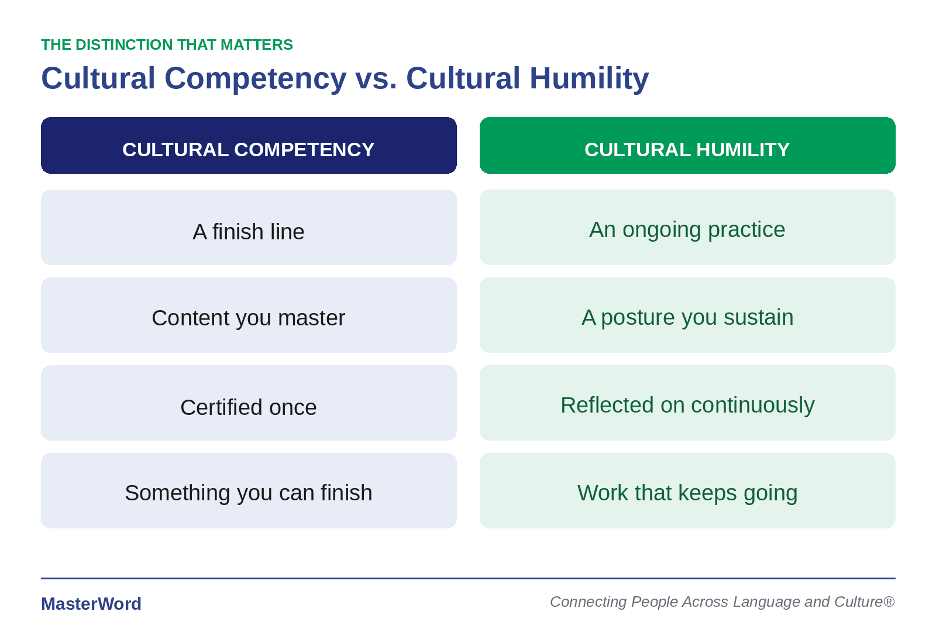
“Competency” implies a finish line. You study a culture, you complete the module, you’re now competent. The Health Expectations team, building a practical framework for working with people from diverse groups, found that framing wears thin in practice. Cultural understanding isn’t a fixed quantity you possess. It shifts with every patient, every community, every encounter that doesn’t match the training slide.
So the researchers proposed a different word: cultural humility. And in their consensus workshop, they made a telling move. Recommendations first written as things teams “could” do were rewritten as things they “should” do. Cultural understanding stopped being optional and became the default standard. It’s worth noticing that the Joint Commission already points the same direction. Its expectation isn’t a single certificate. It’s training delivered at intervals, kept going, treated as ongoing work.
Where the idea actually came from
Cultural humility isn’t new branding. Melanie Tervalon and Jann Murray-García defined it in 1998 as a lifelong commitment to self-evaluation and self-critique, to redressing power imbalances, and to building partnerships with communities that aren’t paternalistic. The key word is lifelong. There’s no certificate at the end because there’s no end.
It’s worth being honest here. Plenty of serious scholars argue that competency and humility are complementary rather than opposed, and they have a point. Knowledge matters. You can’t reflect your way out of not knowing that a nod doesn’t always mean yes. But the distinction holds where it counts: a posture you keep will outperform a credential you store, every time the situation in front of you fails to match the one you trained for.
What this changes for the people in the room
Bring it to the bedside. A clinician who completed a cultural competence module years ago isn’t equipped, by that fact alone, for the patient in front of them today, whose hesitation might be modesty, mistrust, or a belief about illness the chart doesn’t capture. The skill that matters is noticing, asking, and adjusting in the moment. That isn’t certified once and held. It’s practiced.
The same is true for the interpreter, whose work isn’t only moving words from one language to another. It’s carrying what a phrase actually holds: deference, shame, a refusal dressed up as agreement, a “fine” that means anything but. For clinician and interpreter alike, quality is better understood as a practice than a qualification. The module sets a floor. The ceiling comes from what each person does with every encounter after it. The ones who stay sharp are the ones who keep asking what they missed.
Why AI forces the question
Nowhere does the distinction get sharper than with AI. A 2026 review in the natural language processing field, drawing on more than fifty studies, reached a blunt conclusion: multilingual capability and cultural competence come apart. A model can be fluent in a language and still flatten local norms, misread culturally grounded cues, and underperform for the very communities it appears to serve.
That should change how organizations evaluate any AI language tool. The question isn’t whether it speaks the language. Plenty of tools speak the language. The question is whether it carries the meaning, and whether anyone is checking on that continuously rather than at the moment of purchase. Speaking a language and understanding what’s being said through it are different things, for a machine as much as for a person.
Where the stakes are highest
The cost of getting this wrong isn’t theoretical. In trauma-informed care, recent work in TESOL Quarterly shows how language itself becomes part of healing or part of the harm. A patient disclosing abuse, a survivor giving testimony, a parent consenting to a child’s treatment: these are moments where the cultural framing around the words decides whether the exchange helps or wounds. A credential checked years ago offers no protection there. Attention in the moment does.
The better question to ask
So the standard worth holding isn’t whether your clinicians, staff, interpreters, or tools are culturally competent, as if that were a status to verify once and forget. It’s how cultural understanding is sustained across the whole workforce a patient encounters: in how clinicians are trained and retrained, in how staff are supported, in how interpreters are developed, and in how any AI tool is tested after the contract is signed. Language services are one part of that system, not the whole of it.
That’s also, read closely, what the Joint Commission’s expectation of ongoing training is really asking for. Competency sounds like something you can finish. The work of caring for people across language and culture never is. Build for the practice that keeps going, and the credential takes care of itself.