


A new study in the Journal of General Internal Medicine names the safety work AI interpreting tools don't yet support.
The visit is over. The doctor asked if there were any questions, and the patient said no. Then, on her way out, she turns to the interpreter and asks about something the doctor said.
Interpreters say this happens often, and now it’s in the peer-reviewed record. A study published Oct. 5, 2026, in the Journal of General Internal Medicine asked experienced medical interpreters what they do during diagnostic visits beyond interpreting the words. Their answers added up to eleven distinct behaviors. The authors’ conclusion belongs in front of anyone evaluating AI interpreting: AI interpretation tools don’t yet support those behaviors.
Accuracy is the wrong finish line
Most conversations about AI interpreting come down to accuracy. Get the words right often enough, the thinking goes, and the tool is ready.
The researchers, led by a team at UTHealth Houston, call that belief tempting, then explain what it misses. Treating AI as a safe, effective, low-cost alternative once it meets an accuracy threshold “overlooks the other actions interpreters may take to enhance resilience and, therefore, safety.”
Resilience is a patient-safety term. It describes a care team’s ability to adjust before, during or after something goes wrong, so care stays safe. The researchers used that lens to ask where interpreters contribute. They found interpreter behaviors in every part of it.
What the interpreters described
The team ran three focus groups with 12 certified medical interpreters. Each had five to 24 years of experience, and all worked in English and Spanish. Five former interpreters reviewed the findings. The eleven behaviors fall into four groups.
They respond. They cue clinicians and patients to speak in short segments so the interpretation stays accurate. They carry a patient’s hesitation and emotion along with the words, so the clinician hears what the patient is holding back. They stay with the patient from arrival until the follow-up is scheduled. And they value a short pre-brief with the clinical team, so they know the terminology and the emotional context before the visit starts.
They monitor. They watch the gap between what a patient says and what the patient understands. They notice when the dynamic between clinician and patient is undermining communication. They catch technology problems, from a poor video connection to a badly placed screen to errors from AI translation tools. Some described stepping in after overhearing inaccurate machine-generated Spanish while walking past a clinic room.
They learn. Interpreters who share a patient’s cultural background use it to draw out sensitive information and to navigate diagnostic tests that don’t fit the patient’s culture. With experience, they grow more confident speaking up for patients, within their standards of practice.
They anticipate. Some patients come from cultures that see medicine as infallible. If their symptoms persist after a visit, they may conclude it’s their own fault. An interpreter who recognizes that can flag it so the clinician addresses it before the patient drops out of care. Interpreters also proposed system fixes, such as guidelines for when to use video or in-person interpreting, and gender-matched interpreters for urology, gynecology and mental health visits.
What the transcript shows | What the interpreter also did |
“Any questions?” “No.” | Noticed the patient hadn’t understood, and fielded her question after the visit |
An accurate rendering of the patient’s answer | Carried the hesitation that told the clinician there was more to ask |
The visit ends on schedule | Flagged a patient at risk of not returning for follow-up testing |
Words exchanged over video | Noticed the connection and screen placement were getting in the way |
Examples drawn from the study’s findings.
It’s a small, qualitative study, built on interpreters’ own accounts. The authors call for real-world testing that compares AI tools with interpreters. What it does well is name the work, so buyers know what to look for.
When nobody is doing that work
A separate study, published online in JAMA Surgery on Sept. 16, 2026, shows what happens when that work is missing. Researchers reviewed video of 291 patient encounters at six level I trauma centers. Physicians introduced themselves to 34.1% of English-speaking patients and 6.1% of Spanish-speaking patients. Spanish-speaking patients received physical reassurance far less often (13.7% vs. 51.5%) and a complete physical exam far less often (13.7% vs. 38.6%).
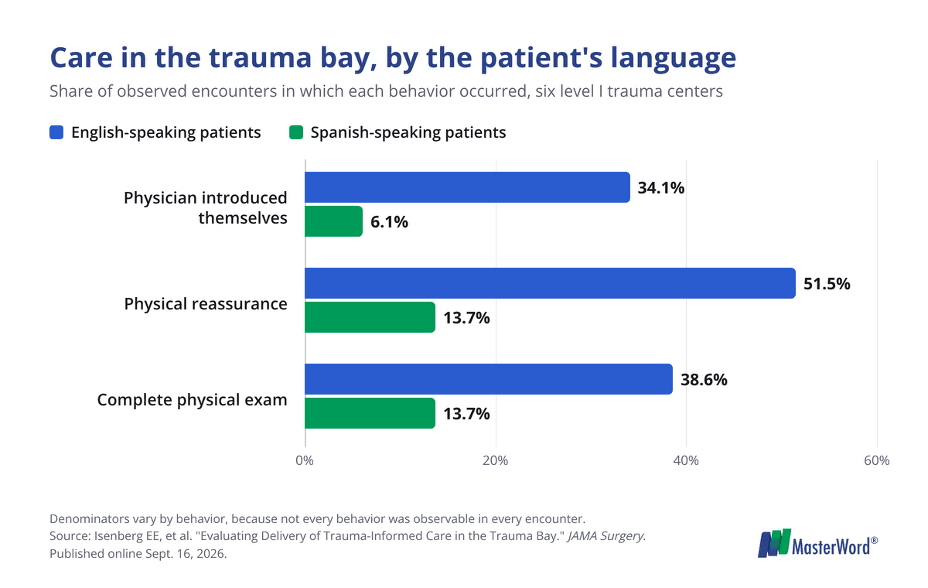
Clinicians relied on ad hoc interpretation in 88% of the Spanish-speaking encounters. Only 13.5% had a professional interpreter for the complete evaluation.
The authors found the gaps even in behaviors that don’t depend on language, and they say closing them will take more than better interpreter use. The picture still fits the JGIM findings. When no one in the room is watching for understanding and carrying the patient’s voice, a lot of that work goes undone.
Where AI fits, by the study's own account
The JGIM authors describe two possible futures for AI. In one, AI tools draw on video or health-record data to flag when a patient may be misunderstanding or when a cultural difference matters. In the other, “AI as teammate,” interpreters oversee AI interpretation and move further into the role of cultural advocate and navigator.
Either way, they write, AI tools and their workflows “should be designed with consideration to the resilience behaviors.” That gives buyers a practical test. When a vendor shows you an accuracy score, ask three questions:
- What does the tool do when a patient says “no questions” and doesn’t mean it?
- Who notices when the video connection is failing the conversation?
- What happens when the visit turns serious, and how fast does a qualified interpreter take over?
That’s how we approach AI at MasterWord. The stakes of the encounter decide how much AI belongs in it, and anyone can ask for a human interpreter.
Start before the door opens
The study’s simplest recommendation costs almost nothing. Interpreters said medical hierarchy can make it hard to raise a concern with a clinician. The authors’ fix is a short pre-brief, where the clinician tells the interpreter what the visit is about and says plainly that they want to hear any concern that could affect patient safety.
For a clinic manager, that’s a workflow change with no equipment to buy. A few minutes before the visit, and the patient’s question gets asked in the exam room, where the doctor can answer it.
Sources
Samost-Williams A, Wermuth P, Fernández Castillo G, et al. “The Role of Interpreters in Supporting Resilience and Implications for Artificial Intelligence.” Journal of General Internal Medicine. Published Oct. 5, 2026. doi.org/10.1007/s11606-026-10850-4
Isenberg EE, et al. “Evaluating Delivery of Trauma-Informed Care in the Trauma Bay.” JAMA Surgery. Published online Sept. 16, 2026. jamanetwork.com/journals/jamasurgery/fullarticle/2854295